Best Portable Speakers for Every Adventure
Whether you're at the beach, the campsite, or your buddy's backyard, the right portable speaker turns any situation into a good time. Here's a no-nonsense guide to finding the best one for how you actually live.
· 10 MIN READ
The first portable speaker I ever owned was a small cylinder that my aunt got me for Christmas in 2018. It sounded like music being played inside a tin can that was also inside another, slightly larger tin can. The bass response could generously be described as "theoretical." It connected to Bluetooth about sixty percent of the time, and the other forty percent it played whatever the last person who connected to it was listening to, which was my roommate's Gregorian chant phase. Not ideal.
I've since spent an unreasonable amount of time and money testing portable speakers across every scenario a normal person might encounter: beach days, camping trips, pool parties, tailgates, living room hangouts, shower singing sessions, and that very specific situation where you're grilling in the backyard and need something loud enough to hear over the sizzle but not so loud that your neighbor Greg comes over to "casually" mention the noise. We all know a Greg.
Here's what I've learned, organized by the way most guys actually use these things.
The Beach and Pool Speaker: Waterproof or Don't Bother
If your speaker is going anywhere near water -- and if you own a speaker for more than three months, it will end up near water whether you planned it or not -- waterproofing isn't a feature. It's a requirement. I learned this when my buddy Kyle tossed my non-waterproof speaker into the cooler "to keep it safe" and condensation killed it within an hour. Thanks, Kyle. That was $80.
You want an IP67 rating at minimum. That means the speaker can survive being submerged in a meter of water for thirty minutes. Not that you're planning to take it scuba diving, but between pool splashes, beach waves, unexpected rain, and friends like Kyle, submersion-level protection is the baseline.
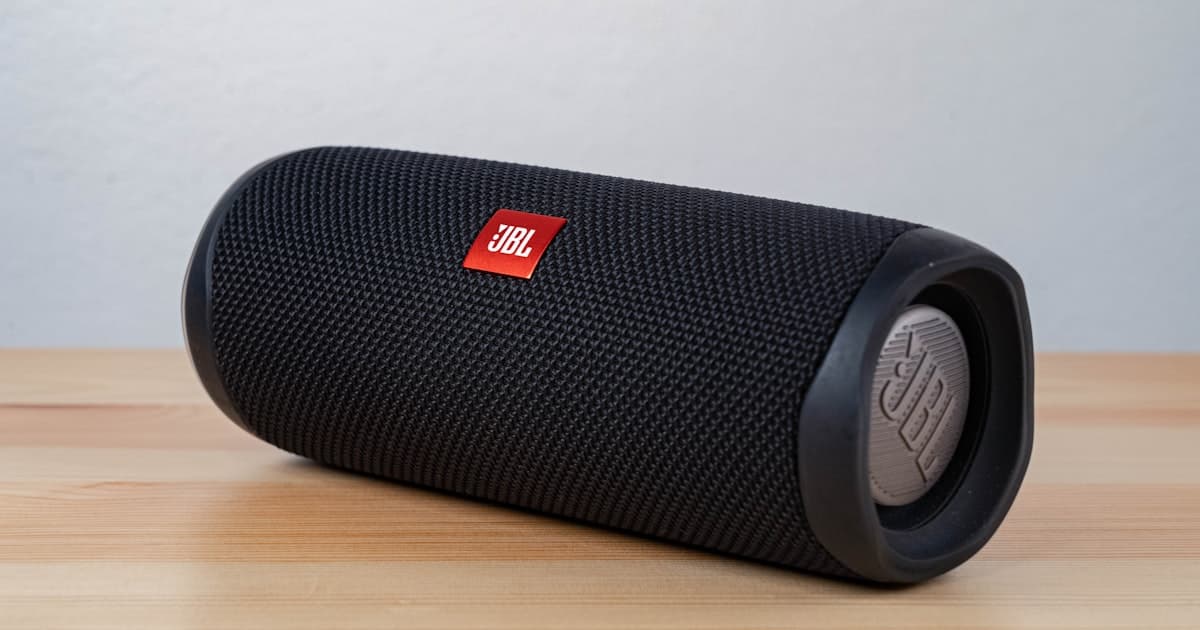
The JBL Charge 5 is the king of this category. It sounds bigger than it looks (always a good sign), the battery lasts about 20 hours (JBL says 20, real-world testing says about 17-18, which is still phenomenal), it's fully waterproof and dustproof, and it doubles as a power bank so you can charge your phone. It runs about $180, goes on sale regularly, and it's one of those products where the hype is entirely justified.
If you want something smaller, the JBL Flip 6 is the Charge 5's little sibling at about $100-130. Slightly less bass, smaller size, same waterproofing. It fits in a backpack side pocket and sounds genuinely impressive for its size. I've taken mine to the beach probably forty times, and it has survived sand, salt water, sunscreen spray, and a direct hit from a rogue football. Still works perfectly.
Budget pick: the Tribit StormBox Micro 2. About $60, surprisingly good sound for the price, IP67, and so small you forget you're carrying it. It won't blow anyone's mind with audio quality, but for the price, it's absurdly good.
The Camping and Hiking Speaker: Tough, Light, and Long-Lasting
When you're packing for a camping trip, every ounce counts. You're already carrying a tent, a sleeping bag, food, water, and whatever optimistic fishing gear you bought because "this is the trip you're finally going to use it." Your speaker needs to be small enough to clip to a backpack and light enough that you don't notice it during a hike.
The Bose SoundLink Flex is built for this. It weighs about a pound, has a carabiner clip for easy attachment, sounds remarkably full for its size, and Bose claims the battery lasts 12 hours (I've gotten about 10-11 at moderate volume, which is enough for a full day outdoors). It's IP67 waterproof, built like a small tank, and the PositionIQ feature adjusts the sound profile based on how you've positioned it -- hanging, standing upright, or flat. Clever engineering that actually makes a difference.
Background reading: The Verge reviews.
The Ultimate Ears Wonderboom 3 is another excellent option at around $80-100. It's shaped like a small barrel, it floats (genuinely useful when camping near water), and the 360-degree sound means everyone sitting around the campfire hears the music equally. No "good side" and "bad side" to the speaker, which eliminates the awkward musical chairs that happens with directional speakers.
One thing I look for in a camping speaker that also relates to comfort: physical controls that work without looking at a screen. When your hands are dirty, you're wearing gloves, or it's dark and your phone is dead, being able to skip tracks and adjust volume with tactile buttons is essential.
The Backyard and Tailgate Speaker: Turn It Up
Different situation, different requirements. When you're hosting a cookout, a tailgate, or any outdoor gathering with more than about six people, the little Bluetooth cylinder isn't going to cut it. You need volume. Real, fill-a-space, my-neighbor-can-hear-this-three-houses-away volume.
The JBL Boombox 3 is the nuclear option. It's big. It's heavy (about 14 pounds). It costs about $450-500. And it sounds like a full-size stereo system decided to go portable. The bass on this thing is physical -- you feel it in your chest. Battery life is about 24 hours. I brought one to a Fourth of July party and it handled a full day of music, through the grilling, through the fireworks, through the "let's keep hanging out even though the mosquitoes are winning" phase, and still had battery left the next morning.
If $500 is too steep (and it probably should be unless you're throwing large outdoor gatherings regularly), the JBL Xtreme 3 hits a sweet spot around $280-330. It's smaller and lighter than the Boombox but still gets genuinely loud. Waterproof, long battery life, and portable enough that one person can carry it comfortably. This is the sweet spot for most guys.
The Marshall Middleton is the style pick in this tier. Around $250, it looks like a miniature guitar amp, and it sounds warm and full in a way that's distinctly Marshall. If you care about aesthetics -- and it's okay to care about aesthetics -- this is the speaker that looks good sitting on a patio table next to your drinks. It also sounds excellent, with a slightly warmer tone than the JBL line. Think of it as the leather jacket of portable speakers.
(For related context, see Every Gadget in My EDC Kit and Why I Can't Leave Home Without Them.)
The Shower Speaker: Yes, This Is a Real Category
I didn't think I needed a shower speaker until I had one, and now I can't imagine showering without music. It's the same transformation as getting a bidet -- once you experience it, going back feels barbaric.
The requirements here are simple: fully waterproof (obviously), suction cup mount (so it sticks to your shower wall), decent sound (it doesn't need to be amazing because your bathroom acoustics are doing most of the work), and a price point low enough that you don't wince when it inevitably falls into the tub.
The JBL Go 4 is perfect for this. Around $50, IP67 waterproof, and small enough to suction-cup to a tile wall without looking like you've installed a surveillance device in your shower. Sound quality is solid for a speaker the size of a deck of cards. Battery lasts about seven hours, which is about 140 showers' worth of music if you're a normal human being who showers for about three minutes. Longer if you're the kind of guy who treats the shower as a thinking room, which I absolutely am.
The Desk or Nightstand Speaker: Small but Mighty
Sometimes you don't need a speaker for adventure. You just need something that sounds better than your laptop's built-in speakers (which sound like music is being played through a cardboard tube) for your work-from-home setup, bedroom, or kitchen counter.
The Sonos Roam 2 lives in this space perfectly. It's about $180, sounds phenomenal for its size, works with Bluetooth and WiFi, integrates with your Sonos system if you have one, and has automatic Trueplay tuning that adjusts the sound to your room. I keep mine on my desk during work hours and take it to the kitchen when I'm cooking. The ability to switch between WiFi (at home) and Bluetooth (on the go) makes it genuinely versatile.
Source for the claims above: Ars Technica.
The Bose SoundLink Mini II Special Edition is another strong contender at about $120-150. It's been around for years because it's that good. Deep bass that has no business coming from a speaker this small, a clean design that looks good on a shelf, and dead-simple Bluetooth pairing. It's not waterproof, which limits its outdoor utility, but for indoor use it's hard to beat.
If your interest in audio extends to what you put on your head, the same brands that make great speakers tend to make great headphones. The listening experience from a quality speaker versus quality headphones is different but equally important.
How to Pick: The Decision Framework
If you're only buying one speaker and need it to cover the most situations:
Under $100: JBL Flip 6. Waterproof, portable, sounds great, goes everywhere. It's the Honda Civic of portable speakers -- reliable, versatile, and nobody's ever regretted buying one.
$100-200: JBL Charge 5. Everything the Flip does, but louder, with longer battery life and a phone-charging feature. This is the one I recommend to most people because it handles 90% of situations without compromise.
$200-300: Marshall Middleton if you care about style, JBL Xtreme 3 if you care about volume. Both are excellent. Both will last years.
$300+: JBL Boombox 3 if you're the designated party host and need enough volume to fill a yard. This is not a casual purchase. This is a lifestyle commitment.
Take Care of Your Speaker
A few quick tips that'll extend the life of whatever you buy:
Don't leave it in direct sunlight for extended periods. Heat degrades battery capacity over time. A speaker that gets 20 hours when new might get 12 after a summer of being left on a hot dashboard.
Charge it before storage. If you're putting it away for the winter, charge it to about 50-80% first. Storing a lithium battery at zero charge is how batteries die prematurely.
Clean the grille occasionally. A soft brush or compressed air keeps dust and sand out of the drivers. Sand in a speaker is like sand in a sandwich -- everything still technically works, but the experience is significantly worse.
And don't blast it at full volume constantly. Running any speaker at maximum volume for extended periods distorts the sound, wears out the drivers faster, and annoys everyone within a three-block radius. Keep it at 70-80% for the best balance of volume and sound quality. Your ears, your speaker, and your neighbor Greg will all thank you.
Further reading and primary sources
Background and primary-source references for the claims and recommendations above. Linked references are intended for readers who want to verify a claim, dig deeper into a topic, or check the underlying data themselves.
- The Verge reviews — long-form consumer-tech reviews with measured performance data.
- Ars Technica — technical consumer-tech and computing journalism, deeper than mainstream tech press.
- Wired — established consumer-tech and digital-culture publication.

About the writer
Marcus Hale
Senior writer — Tech & Money
Read more from Marcus — full archive, full bio, and contact on their writer page.
Share this story
More from Marcus
Spot a problem with this piece? Email info@luba.media.