Basic Car Maintenance Every Guy Should Know How to Do
I once paid a shop $80 to replace a cabin air filter that takes literally two minutes and costs $12. Never again. Here's everything I've learned about keeping a car alive without getting ripped off.
· 14 MIN READ
I'm going to tell you something embarrassing. In my mid-twenties, I drove a 2009 Honda Accord with the oil light on for three weeks because I thought it was "just a suggestion." Like the car was politely recommending I consider, at my leisure, maybe topping off the oil. It was not a suggestion. It was a scream for help. The engine started making a noise that I can only describe as a bag of marbles inside a blender, and my mechanic looked at me the way a doctor looks at someone who WebMD'd their way into ignoring chest pain.
That car survived, barely, but the repair bill was $1,400 and the lecture from my dad was free and somehow more painful. That was the moment I decided to actually learn how to take care of a car. Not become a mechanic -- just stop being the guy who treats his vehicle like a magic box that goes forward when you push the pedal.
Here's what I've learned since then. None of this is hard. Most of it takes less time than watching an episode of something on Netflix. And the money you'll save is real -- we're talking hundreds, sometimes thousands of dollars a year. If you're keeping an older car on the road (and if you need recommendations on which ones are actually worth it, check out our guide to the best used cars under $15K that won't leave you stranded), knowing this stuff is the difference between a reliable daily driver and an expensive paperweight.
Checking and Changing Your Oil
This is the big one. Oil is your engine's blood. It lubricates all the metal parts spinning at thousands of RPM so they don't grind themselves into expensive confetti. Over time, oil breaks down, gets contaminated, and stops doing its job. Ignore it long enough and you end up like 25-year-old me, staring at a four-figure repair bill and questioning every life choice that led to this moment.
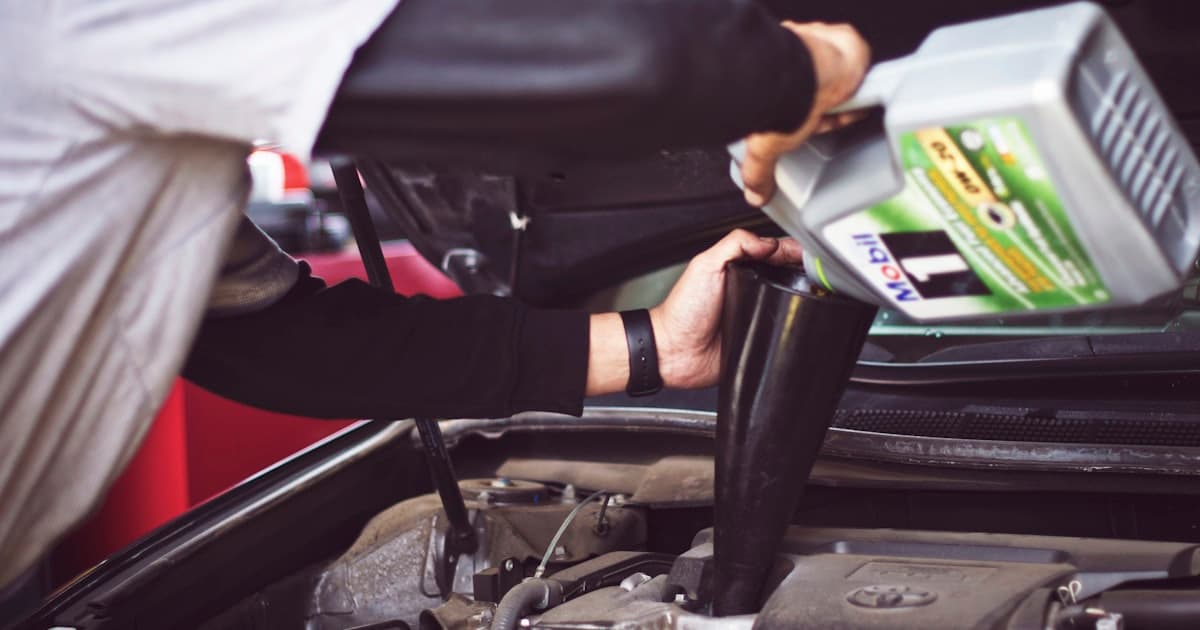
Checking your oil is the easiest thing in the world. Pop the hood, find the dipstick (it usually has a yellow or orange handle), pull it out, wipe it off, stick it back in, pull it again, and read the level. If it's between the two marks, you're good. If it's low, add some. The whole process takes 45 seconds and will save you from the kind of catastrophic engine damage that makes grown men cry.
Changing the oil yourself is only slightly more involved. You need a socket wrench, an oil filter wrench, a drain pan, the right oil and filter for your car (your owner's manual tells you exactly what to get), and about 30 minutes. A full synthetic oil change at a shop runs $75-100 these days. Doing it yourself costs about $30-35 for five quarts of Mobil 1 and a filter from AutoZone. That's $40-65 in your pocket every 5,000 miles.
The first time I changed my own oil, I forgot to put the drain plug back in before pouring in the new oil. Four and a half quarts went straight through the engine and onto my garage floor like I was recreating that elevator scene from The Shining, but with Pennzoil. Lesson learned. Put the plug back first.
Tire Pressure and Rotation
Here's a fun fact that most people don't know: underinflated tires are one of the biggest killers of fuel economy. The US Department of Energy's fueleconomy.gov puts the figure at roughly 0.2% loss per 1 PSI under spec across all tires (so up to 3% if you're seriously low across the set). That adds up fast. It also wears your tires unevenly, which means you're replacing $600-800 worth of rubber sooner than you need to.
Checking tire pressure takes about two minutes with a $10 digital gauge from Amazon. Your car's recommended pressure is on a sticker inside the driver's door jamb -- not on the tire sidewall, which shows the maximum pressure, not the ideal. I check mine roughly once a month, usually on a Sunday morning when I'm already in the garage pretending to organize things.
Tire rotation is the other half of this equation. Your front tires wear faster than your rears (especially on front-wheel-drive cars) because they handle both steering and most of the braking force. Rotating them every 5,000-7,500 miles evens out the wear pattern and can add 10,000-15,000 miles to a set of tires. A shop charges $30-50 for this. If you have a jack and a set of jack stands (about $60 total, one-time purchase), you can do it yourself for free. It takes maybe 30 minutes once you've done it a couple times.
I'll be honest: I rotate my own tires about half the time. When it's 95 degrees in the garage and I'm already sweaty from existing, I'll just pay the $30. No shame in that.
Replacing Your Air Filters
This is the one that turned me into a DIY convert, because this is where shops genuinely rip people off.
Your car has two air filters: the engine air filter and the cabin air filter. The engine filter keeps dust and debris out of the intake so your engine breathes clean air. The cabin filter does the same for the air coming through your vents so YOU breathe clean air. Both need replacing roughly every 15,000-20,000 miles.
Here's the scam: shops charge $40-80 for the engine air filter and $50-80 for the cabin filter, labor included. The parts themselves? The engine filter is $12-20 at any auto parts store. The cabin filter is $10-18. And both take less than five minutes to swap, with zero tools required on most cars.
The engine air filter is usually in a plastic box near the top of the engine. Pop a couple of clips, lift the lid, pull out the old filter, drop in the new one. Done. The cabin filter is typically behind the glove box -- you squeeze the sides of the glove box to release it, and the filter slides right out. I timed myself once. Cabin filter swap: one minute and forty seconds. That shop wanted $80 for that. Eighty dollars for less than two minutes of work that requires the mechanical aptitude of a golden retriever.
Replacing Wiper Blades
Wiper blades are one of those things you forget about until it's pouring rain on the highway at night and your windshield looks like you're peering through a shower curtain. Then it becomes very urgent very fast.
New blades cost $15-25 for a pair at basically any auto parts store. Bosch Icon are my go-to -- they last about a year before they start streaking, which is better than most. The swap takes about three minutes. Every wiper blade package has instructions, and there are roughly a million YouTube videos for your specific car. You don't need tools. You just unclip the old one and click the new one on.
Shops charge $40-60 for this. Some dealerships charge even more. For a job that is, and I mean this literally, easier than changing a lightbulb.
I keep a spare set of wipers in my trunk at all times because I once got caught in a downpour in the mountains with blades so worn they were basically just smearing water around in artistic patterns. Having spares in the trunk is the kind of paranoid preparedness that I picked up from building out my everyday carry kit -- same energy, different context.
Brake Pads
Okay, now we're getting into territory that sounds scarier than it actually is. Brakes are the thing that stops your two-ton metal box from hitting other things, so yeah, they're important. But replacing brake pads is genuinely not that hard, and the savings are substantial.
A shop charges $150-300 per axle for a brake pad replacement. The pads themselves cost $25-50 for a set of quality ceramics (I use Wagner ThermoQuiet on my current car). You need a jack, jack stands, a socket set, a C-clamp, and about an hour your first time. After you've done it once, it takes maybe 40 minutes.
The process: jack up the car, remove the wheel, unbolt the caliper, slide out the old pads, compress the caliper piston with the C-clamp, slide in the new pads, bolt the caliper back on, put the wheel back on. That's it. That's literally the whole job.
(For a related angle, see How I Went From Couch Potato to Running a Half Marathon in 6 Months.)
My first time doing brake pads, I was so nervous I watched four different YouTube videos, laid out every tool like a surgeon, and called my dad to have him on standby. Then I did it and sat there thinking, "Wait, that's it?" The hardest part was getting the caliper bolt loose because the previous shop had apparently tightened it with the wrath of God. A breaker bar solved that in about three seconds.
One note: if your rotors are worn or warped (you'll feel pulsing in the brake pedal), you'll want to replace or resurface those too, which adds some cost and complexity. But for a standard pad swap on rotors that are still in good shape, this is a Saturday morning job.
Battery Replacement
Car batteries die. It's not a question of if, it's when. Most last 3-5 years, and they have an incredible talent for dying on the coldest morning of the year or when you're already late for something important.
A new battery costs $100-180 depending on the size and brand. Interstate and DieHard are solid choices. A shop charges $20-50 for installation on top of the battery cost. Doing it yourself takes about 15 minutes and requires a single wrench (usually 10mm).
The process: disconnect the negative terminal first (this is important -- negative first, always), then the positive. Remove the hold-down bracket, lift out the old battery, drop in the new one, reconnect positive first, then negative. Clean the terminal connections with a wire brush or one of those $5 battery terminal cleaners. Done.
The reason I emphasize "negative first, positive first" for reconnection is that if you do it backwards, you risk a short circuit. I've never personally shorted a car battery, but my neighbor did, and the resulting spark was impressive enough that his eyebrows took a few weeks to fully recover.
Coolant
Coolant, or antifreeze, keeps your engine from overheating in summer and from freezing in winter. It circulates through the engine and radiator in a closed loop, absorbing heat and dissipating it. If it gets low or old, your engine overheats, and an overheated engine can warp the cylinder head, blow a head gasket, or seize entirely. We're talking $2,000-5,000 in damage.
Checking your coolant level takes ten seconds: look at the translucent reservoir under the hood and see if the fluid is between the min and max lines. If it's low, top it off with the correct type for your car (check the manual -- mixing the wrong types can cause problems). A gallon of premixed coolant costs about $12.
A full coolant flush -- draining the old stuff and replacing it -- should be done every 30,000 miles or so. Shops charge $100-150 for this. Doing it yourself costs about $20 in coolant and takes maybe 30 minutes. Drain the radiator via the petcock valve at the bottom, flush with distilled water, then fill with fresh coolant. The biggest hassle is disposing of the old coolant properly -- most auto parts stores accept it for free.
I learned the importance of coolant on a road trip through Arizona in August when my temperature gauge started climbing toward the red zone on a stretch of I-10 with nothing around for 30 miles. Turned out I was about a quart low. I had a jug of coolant in the trunk because my dad drilled it into me after the oil incident. Thanks, Dad.
Jump-Starting a Car
If you own a car long enough, you will need a jump. Maybe you left the interior light on overnight. Maybe the battery is dying and finally gave up. Maybe it's February and physics is just being cruel. Whatever the reason, you need to know how to do this.
The traditional method requires jumper cables and a willing stranger with a running car. Red clamp on the dead battery's positive terminal, red clamp on the good battery's positive terminal, black clamp on the good battery's negative terminal, and then -- this is the part people get wrong -- the last black clamp goes on an unpainted metal surface on the dead car's engine block, NOT on the dead battery's negative terminal. This prevents sparking near the battery, which can off-gas hydrogen. Hydrogen plus spark equals bad day.
Start the good car, let it run for a couple minutes, then try starting the dead car. Once it's running, disconnect in reverse order. Drive around for at least 20-30 minutes to let the alternator recharge the battery.
Honestly though? Buy a portable jump starter. The NOCO Boost Plus GB40 is $100, fits in your glove box, and can jump your car without needing another vehicle. I've used mine four times -- twice for myself, twice for strangers in parking lots. Both strangers looked at me like I'd performed actual magic. It's the most satisfying $100 I've ever spent.
Changing a Flat Tire
I put this last because it's the one most people think they know how to do but have never actually done. And let me tell you, the side of a highway at 11 PM is a terrible place to learn.
Every car comes with a jack, a lug wrench, and (usually) a spare tire. Here's the actual process: pull over somewhere safe and flat, turn on your hazards, loosen the lug nuts slightly while the car is still on the ground (this is key -- if you jack it up first, the wheel just spins), place the jack under the designated lift point (check your manual), raise the car, remove the lug nuts, swap the flat for the spare, hand-tighten the lug nuts in a star pattern, lower the car, then fully tighten the lugs. Drive to the nearest tire shop -- most spares are only rated for 50 mph and 50-70 miles.
A tow for a flat tire costs $75-150. Knowing how to swap it yourself costs you about 15 minutes of mild inconvenience. And while you're at it: NHTSA's tire safety guide has the full primer on tread depth (replace at 2/32"), age (most manufacturers say replace at 6 years regardless of tread), and the DOT date code stamp on the sidewall that tells you when the tire was actually built. Worth knowing before a long road trip.
I practiced in my driveway on a Saturday afternoon before I ever needed to do it for real, and I'd recommend the same. The first time I actually had a flat -- middle of nowhere, 10 PM, light rain -- I was genuinely grateful I'd done that dry run. Everything went smooth. Well, almost everything. I did get my khakis dirty kneeling on the shoulder, which my wife found hilarious rather than sympathetic.
The Bottom Line
Nobody's asking you to rebuild a transmission in your garage. That's what professionals are for. But these nine things? They're basic literacy for anyone who owns a car. They save you real money -- we're talking $500-1,000+ per year if you're currently paying a shop for all of it. More importantly, they give you a relationship with your car that goes beyond "I put gas in it and hope for the best."
There's something deeply satisfying about popping the hood, diagnosing a simple problem, and fixing it yourself. It's the same feeling as cooking a great meal instead of ordering delivery, or assembling furniture without leftover screws. You built something. You fixed something. You are, briefly, competent in a way that our increasingly hands-off, subscription-based, "leave it to the professionals" world doesn't always encourage.
Start with the easy stuff. Change your air filters this weekend. Check your tire pressure tomorrow morning. And the next time your oil light comes on, do not -- I repeat, do not -- treat it as a gentle suggestion. That's your car begging you to care. Listen to it.
Sources

About the writer
Daniel Reyes
Senior writer — Fitness, Cars & Sports
Read more from Daniel — full archive, full bio, and contact on their writer page.
Share this story
More from Daniel
Spot a problem with this piece? Email info@luba.media.