Best Midsize Trucks for Guys Who Don't Need a Monster
Not everyone needs a 6,000-pound full-size truck to haul mulch twice a year. Here are 7 midsize trucks that deliver real truck utility without the absurd price tag, parking nightmares, and single-digit fuel economy.
· 16 MIN READ
I need to get something off my chest: the full-size truck market has lost its mind. A base-model F-150 XLT now starts north of $44,000. A decently equipped Silverado will run you $52K before you even sniff at leather seats. RAM 1500 Limiteds are pushing seventy grand. Seventy thousand dollars for a pickup truck. My parents bought their first house for less than that.
And for what? So you can haul a couch from IKEA twice a year and tow a boat you use three weekends a summer? So you can parallel park a vehicle the size of a studio apartment in a downtown parking garage built in 1974? So you can enjoy the thrill of watching $130 worth of gasoline vanish every week?
I get it. Full-size trucks are awesome. I grew up around them, I've driven plenty of them, and I've had moments behind the wheel of a properly loaded Super Duty where I felt like I could tow a continent. But for 80% of the guys who buy trucks, a full-size is massive overkill. You don't need 13,000 pounds of towing capacity to pull a utility trailer. You don't need a 6.5-foot bed when you're hauling bags of topsoil and the occasional piece of furniture. And you definitely don't need a $700-a-month payment for the privilege.
Enter the midsize truck. Smaller, lighter, cheaper, easier to park, better on gas, and — here's the part that offends the full-size crowd — genuinely capable of doing 90% of what a full-size can do for everyday truck stuff. I've been daily driving, test driving, and obsessing over this segment for years, and the current crop of midsize trucks is the best it's ever been. Here are the ones worth your money and the ones that are mostly hype.
Toyota Tacoma (2024+, 4th Gen)
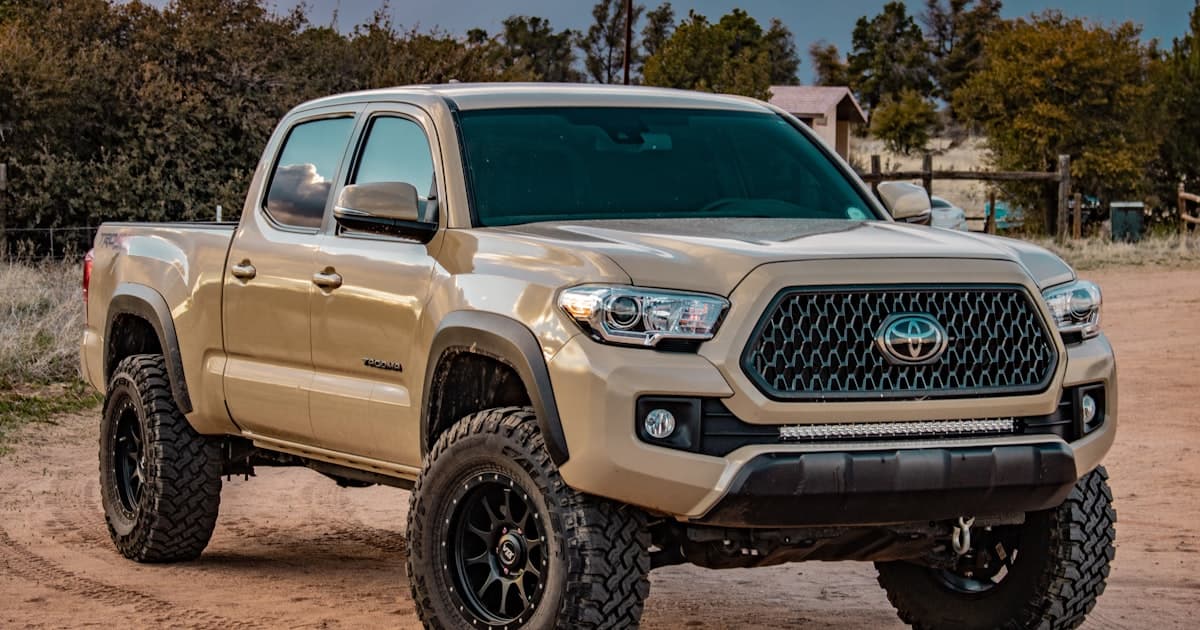
The Tacoma is the 800-pound gorilla of the midsize truck world, and it earned that spot honestly. Toyota's official US sales reports show Tacoma volume in the low-to-mid 200,000s for recent model years — absurd for a midsize truck. People trade in Tacomas with 150,000 miles and get back what feels like an insulting percentage of the original sticker price — insulting to the buyer, because these things hold value like gold bars.
The 4th-gen Tacoma that launched for the 2024 model year is a genuine leap over the outgoing 3rd-gen. The big news is a new 2.4-liter turbocharged four-cylinder making 278 horsepower and 317 lb-ft of torque in most trims (228 hp in the base SR). That's a massive improvement over the old 3.5-liter V6's 278 hp, because you're getting comparable power with significantly better low-end torque and improved fuel economy — expect 21-25 MPG combined depending on configuration. The eight-speed automatic is smooth, and there's still a six-speed manual available on the SR5 and TRD Sport if you're a person of culture.
Towing maxes out at 6,500 pounds, which handles most trailers, small boats, and campers without breaking a sweat. The bed comes in 5-foot or 6-foot lengths. The TRD Off-Road and TRD Pro trims are legitimate off-road machines — multimatic DSSV dampers on the Pro, locking rear diff, crawl control, the whole nine yards.
The downsides? Price. A base SR starts around $32,000, which is reasonable, but a TRD Pro will cost you north of $57,000, and at that point you're basically in full-size territory. The interior, while improved, still feels a notch below the Ranger and Colorado in terms of materials and tech. And the ride quality on pavement is truck-firm in a way that some competitors have managed to smooth out.
But the resale value alone makes the Tacoma a smart buy. You're going to get more of your money back when you sell it than almost any other vehicle in this segment. That's not nothing.
Ford Ranger (2024+, 7th Gen)
The Ranger is the truck I'd tell my best friend to buy if he asked me tomorrow. Ford brought the Ranger back to the US market in 2019 after years of absence, and the current 7th-gen model that debuted for 2024 is a properly excellent truck.
The engine is a 2.3-liter EcoBoost turbocharged four-cylinder making 270 horsepower and 310 lb-ft of torque — nearly identical to the Tacoma's numbers. The ten-speed automatic (yes, ten speeds in a midsize truck) is surprisingly well-calibrated and always seems to be in the right gear. Combined fuel economy sits around 22-26 MPG, competitive with the Tacoma. Towing capacity tops out at 7,500 pounds, which is the best in the midsize class and gives you real breathing room for larger trailers.
Where the Ranger shines over the Tacoma is the on-road experience. The ride is noticeably more comfortable, the cabin is quieter at highway speeds, and Ford's SYNC 4 infotainment system with the 12-inch touchscreen is miles ahead of Toyota's setup. The interior materials feel more upscale — soft-touch surfaces where competitors have hard plastic, actual stitching on the dash, and seats that don't make your back hate you after three hours.
The Ranger Raptor is also a genuine hoss: a twin-turbo 3.0-liter V6 making 405 horsepower, Fox Live Valve shocks, and a chassis tuned by the same team that does the F-150 Raptor. It starts around $57,000, and while that's steep, it's the most fun midsize truck you can buy right now. I drove one through some desert trails outside Moab last year and came back grinning like an idiot.
The main knock on the Ranger is that Ford's reliability reputation is... let's call it "inconsistent." Early 2019-2023 Rangers had some transmission complaints and electrical gremlins. The 2024+ models seem to have ironed most of that out, but if long-term Toyota-level reliability is your top priority, you'll sleep better in a Tacoma.
Chevy Colorado / GMC Canyon (2023+, 3rd Gen)
GM completely redesigned the Colorado and Canyon for 2023, and the result is a genuinely impressive truck that doesn't get nearly enough credit. The Colorado and Canyon are mechanically identical twins — same platform, same engines, same capabilities — with the Canyon getting a nicer interior and a slightly different face.
The standard engine is a 2.7-liter turbocharged four-cylinder with 237 horsepower and 259 lb-ft in base form, or 310 hp and 430 lb-ft in the ZR2 and AT4X trims. That high-output version is a torque monster that makes the truck feel genuinely quick. An eight-speed automatic handles shifting duties. Fuel economy is decent at 21-25 MPG combined, and towing caps out at 7,700 pounds — the best in the segment alongside the Ranger.
The thing that sets the Colorado/Canyon apart is the ZR2 and AT4X off-road trims. The Colorado ZR2, starting around $48,000, gets multimatic DSSV dampers (the same type used in the Tacoma TRD Pro and various race trucks), underbody skid plates, front and rear electronic locking differentials, and 33-inch tires. It's a desert runner masquerading as a daily driver. The GMC Canyon AT4X with the Edition 1 package adds even more premium off-road hardware and a nicer interior, though you'll pay around $63,000 for the privilege — firmly into full-size truck money.
The on-road ride is excellent for a midsize truck. GM's engineers did a good job making the Colorado/Canyon feel composed and comfortable on the highway, and the cabin is reasonably quiet. The infotainment is Google Built-In, which means native Google Maps, Google Assistant, and over-the-air updates.
My gripe? The bed. GM only offers one bed length — 5 feet 2 inches on crew cab, 6 feet 2 inches on extended cab — and if you want the crew cab (which is the one most people buy), that 5-foot-2 bed is honestly kind of short. It's fine for Home Depot runs and weekend projects, but if you regularly haul longer items, you'll feel the squeeze. Also, the base WT (Work Truck) trim is spartan to the point of feeling punitive. Get the LT at minimum.
Nissan Frontier (2022+, 3rd Gen)
The Frontier is the truck for guys who want truck stuff without any of the pretension. Nissan left the previous-gen Frontier basically unchanged from 2005 to 2021 — sixteen years — and people kept buying it because it was cheap, tough, and dead simple. The current 3rd-gen model that arrived for 2022 is a massive upgrade that somehow kept the same straightforward, no-nonsense attitude.
The engine is a 3.8-liter naturally aspirated V6 making 310 horsepower and 281 lb-ft of torque. That's right — no turbo, no direct injection, just a big, simple V6 that sounds great and pulls hard. The nine-speed automatic is the only transmission available, which bums me out a little, but it works well. Fuel economy is the Frontier's weakest point at 18-24 MPG combined, trailing most of the turbo-four competition.
Towing tops out at 6,640 pounds, which is perfectly adequate. The bed comes in 5-foot or 6-foot-1 lengths. The Pro-4X trim adds a rear locking differential, Bilstein off-road shocks, and skid plates for legitimate trail capability, and it starts around $41,000 — significantly less than comparable trims from Toyota and Ford.
Here's the Frontier's secret weapon: value. A well-equipped SV crew cab starts around $35,000, and the Pro-4X at $41K undercuts the Tacoma TRD Off-Road by about three grand while offering similar capability. You get a lot of truck for the money.
The interior is where the Frontier shows its budget roots. It's fine — functional, logically laid out, with a decent 9-inch touchscreen — but the materials can't match the Ranger or Canyon. Ride quality is on the stiffer side, and wind noise at highway speeds is noticeable. But if you just want a real truck that works, costs less than the competition, and has a proven powertrain, the Frontier is hard to argue against.
(Adjacent reading: 15 Legendary Cars That Make Gearheads Lose Their Minds.)
Honda Ridgeline (2024+)
Oh boy, here we go. The Ridgeline. The truck that truck guys love to hate because it's built on a unibody platform shared with the Honda Pilot instead of a traditional body-on-frame chassis. Every time someone posts a Ridgeline online, three guys in the comments inevitably say "that's not a real truck."
To those guys: you're wrong, and I can prove it.
The Ridgeline's unibody construction means it rides like an SUV, which is to say it rides like an actual car instead of a covered wagon. It's the most comfortable truck on this list by a significant margin — the suspension soaks up potholes and expansion joints that would rattle your fillings loose in a Tacoma or Frontier. For a truck you're driving every day in a city or suburb, this matters enormously.
The 3.5-liter V6 makes 280 horsepower and 262 lb-ft, paired with a nine-speed automatic and standard all-wheel-drive on every trim. Fuel economy is a respectable 21-27 MPG combined. Towing maxes out at 5,000 pounds, which is the lowest in the midsize class and the main legitimate argument against the Ridgeline. If you need to tow more than 5,000 pounds regularly, buy something else. Period.
But that 5-foot-4 bed has a trick: the In-Bed Trunk. A lockable, drainable, 7.3-cubic-foot storage compartment under the bed floor that can hold coolers, gear, groceries, or anything else you want to keep secure and out of sight. It's absurdly practical. The dual-action tailgate swings down conventionally or opens to the side like a door, which makes loading and unloading from the side much easier in tight spaces. There's a 400-watt audio system built into the bed for tailgating. Honda thought of everything.
The Ridgeline starts around $40,000 for the Sport trim and tops out around $47,000 for the Black Edition. That's competitive pricing for what is arguably the best daily-driver truck in the segment. If your primary use case is commuting, hauling stuff from the hardware store, occasional camping trips, and maybe towing a small trailer once in a while, the Ridgeline is genuinely the smartest choice on this list. It's just also the one that'll get you roasted at the tailgate by guys who think their Silverado makes them more masculine. Their loss.
Ford Maverick
The Maverick might be the most important truck on this list because it fundamentally changed the question of "who needs a truck." Starting at around $24,000 for the base XL with the standard 2.5-liter hybrid powertrain making 191 horsepower, the Maverick is cheaper than most midsize sedans while offering a 4.5-foot bed, a surprisingly spacious crew cab, and up to 42 MPG city on the hybrid. Forty-two. In a truck.
The hybrid is front-wheel-drive only and can tow up to 2,000 pounds. If that's not enough, the 2.0-liter EcoBoost turbo four makes 250 horsepower, offers available all-wheel-drive, and bumps towing capacity to 4,000 pounds. The EcoBoost gets around 25-29 MPG combined (per the EPA's official fueleconomy.gov listing for the Maverick), which is still excellent.
To be direct: the Maverick is not a traditional midsize truck. It's based on the Ford Escape platform, it's smaller than everything else on this list, and the 4.5-foot bed is genuinely tiny. You can't fit a standard 4x8 sheet of plywood flat in the bed — not even close. The payload capacity of around 1,500 pounds is adequate but not class-leading.
So why is it here? Because for the guy who's been driving a sedan or crossover and thinking, "I wish I had a truck bed for this stuff," the Maverick is the answer. It parks like a car, drives like a car, gets fuel economy like a car, and costs like a car — but it has a bed. You can throw bikes in it. You can haul bags of concrete. You can pick up a Christmas tree without strapping it to your roof like some kind of maniac.
I recommended the Maverick to my buddy who was cross-shopping Rav4s and CR-Vs. He bought the hybrid XLT, and every time I see him he finds a new reason to tell me how right I was. He hauled a dresser last week. Couldn't do that in a RAV4. The Maverick fills a gap nobody else was filling, and Ford can't build them fast enough — dealer markups have been disgusting since launch, though they've finally started calming down in 2026.
Hyundai Santa Cruz
The Santa Cruz is what happens when a Korean automaker looks at the American truck market and says, "What if we made a truck for people who don't actually identify as truck people?" Built on the same platform as the Hyundai Tucson, the Santa Cruz is a unibody "sport adventure vehicle" (Hyundai's words, not mine) that's basically a Maverick competitor with a different personality.
The standard engine is a 2.5-liter four-cylinder making 191 horsepower, with an available 2.5-liter turbo producing 281 horsepower and 311 lb-ft of torque. The turbo model is genuinely quick — 0-60 in about 6.5 seconds, which is faster than most midsize trucks on this list. An eight-speed automatic and available all-wheel-drive round out the drivetrain. Fuel economy ranges from 23-28 MPG combined depending on engine and drivetrain.
Towing tops out at 5,000 pounds with the turbo engine, which is better than the Maverick but still below the body-on-frame competition. The 4-foot-3 bed is the smallest here, which limits its truck utility. Like the Ridgeline, there's a lockable in-bed trunk, and the tonneau cover is a retractable hard panel — a nice touch.
The Santa Cruz's strongest card is the interior. It is, hands down, the nicest cabin in this price range. The 10.25-inch digital instrument cluster and 10.25-inch infotainment screen look premium, the materials are surprisingly upscale for a vehicle starting around $29,000, and Hyundai's suite of standard safety tech is comprehensive. The turbo SEL Premium trim with all the options runs about $43,000 and feels like a $55,000 vehicle inside.
The problem? Nobody's buying them. Hyundai has struggled to market the Santa Cruz effectively, and most truck buyers don't even know it exists. If you can find one at a decent discount — and you can, because they're sitting on lots — it's a lot of truck (or truck-adjacent vehicle) for the money. Just don't expect the resale value of a Tacoma or even a Ranger. The Santa Cruz depreciates like a normal car, which is either bad news or good news depending on whether you're buying or selling.
So Which One Should You Actually Buy?
Here's my honest take after spending way too much time thinking about midsize trucks:
If you want the safest bet: Toyota Tacoma. It's not the best at anything except holding its value and refusing to die. Those are pretty good things to be best at.
If you want the best all-around truck: Ford Ranger. Better ride, better interior, better towing, and the Raptor trim is a riot. Just be prepared for potentially higher maintenance costs down the road.
If you want to go off-road for real: Chevy Colorado ZR2 or Tacoma TRD Pro. Both are legitimately capable machines that will handle anything short of a Rubicon trail.
If you want to save money and don't care about bragging rights: Nissan Frontier. More truck per dollar than anything else on this list.
If your truck is mostly a daily driver: Honda Ridgeline. The most comfortable, the most practical for errands and commuting, and the in-bed trunk is genius. Just ignore the haters.
If you don't really need a "real" truck: Ford Maverick. The hybrid is the best value proposition in the entire automotive market right now. If you've been thinking about a reliable used car under $15K but want something new with truck utility, the Maverick hybrid starts right around $24K and gets 42 MPG. That math is hard to argue with.
And to the "just get a full-size" crowd — the guys who insist that anything smaller than an F-150 is a toy — I hear you. I really do. Full-size trucks are more capable. They tow more. They have bigger beds. They can do things a Tacoma simply cannot.
But can you parallel park yours at the restaurant downtown? Does yours fit in your garage without folding the mirrors in? When's the last time you actually used all 13,000 pounds of that towing capacity? How much are you paying for gas every month? How much was your truck payment again?
That's what I thought.
Midsize trucks aren't a compromise. They're the right tool for the job that most of us actually have. And if you've got the right truck, all you need is a good road — maybe one of America's best driving roads — and a free afternoon. That's not settling. That's living.
Now go buy a truck that actually fits in your garage.
Sources

About the writer
Daniel Reyes
Senior writer — Fitness, Cars & Sports
Read more from Daniel — full archive, full bio, and contact on their writer page.
Share this story
More from Daniel
Spot a problem with this piece? Email info@luba.media.